
About
Red Hill Minerals (RHI: ASX) is one of the more interesting structures on the ASX, chaired by a silent titan of the industry, Josh Pitt, with Michael Wall overseeing day to day operations. RHI doesn’t operate a single mine. The business model is as follows:
Evaluate and Create Opportunities
Systematic Exploration to make Discoveries
Monetise Exploration Success
Focus on Shareholders and People
The model is working, it keeps cash on the balance sheet and keeps dividends flowing back to shareholders. RHI has an iron ore royalty producing, throwing off fully franked dividends on a debt free balance sheet, with a basket of gold and base metals options that the market is effectively getting for free. In this article, I have focused on the main components of the business, mainly the royalties opportunity.
RHI is a very tightly held company with minimal liquidity. Board and management hold ~ 43%, and the top 10 shareholders hold ~75%. This stock has minimal coverage from brokers.
On paper, the current statistics are as follows (as of 10/06/2026);
Ticker - RHI: ASX
Price - $4.58
Market Cap - $294 M
Cash and Receivables - $59 M
Debt - 0
Enterprise Value - $235 M
A big thank you to Rock Stocks for the help with the Geology for this article. Check him out.
Royalties/Earn In
The beauty of the royalty business is that the costs sit with the operating company. You take a slice of every tonne that leaves the tenement without wearing any of the operating, capital and processing headaches. That’s the spine of RHI, the rest is optionality stacked on top.
Onslow Iron Ore Royalty - Producing
The Onslow iron ore royalty is RHI’s backbone and the only producing royalty in the portfolio. The royalty sits over the RHIOJV tenements, which carry a Mineral Resource of 744 Mt at 56.3% Fe. It is a 0.75% Free On Board (FOB) royalty over the Onslow Iron Project, operated by Mineral Resources (MIN: ASX). FOB is similar to NSR but is priced at the port, before ocean freight.
The math is straightforward:
Annual Royalty = Tonnes shipped x Realised FOB A$/t x 0.75%
The Onslow Project reached its 35 Mtpa nameplate capacity in late 2025, and RHI has guided FY26 royalty income of ~$28.7M, underpinned by $ 14.9 M received in H1FY26. Half of that flows back to shareholders as a fully franked dividend, subject to the board’s discretion.
The interesting part is where the upside lives. MinRes has been open about intending to run Onslow above nameplate, and the infrastructure is sized for it:
Three crushes installed with a combined capacity of up to 45 Mtpa. A 10 Mtpa surplus over nameplate is already sitting in the dirt.
Five transhippers in the fleet, sized for 35 Mtpa, with a sixth (Arrived in May) and a seventh on the way (Expected by the end of June). Napkin math suggests another vessel adds roughly 7 MT of annual capacity if cycle times hold and there are no in-port loading bottlenecks (a real risk worth watching). Once commissioned, keep an eye on Lily (sixth) and Karri (seventh) on the Ashburton port tracker.
The sale of the haul road to Morgan Stanley Infrastructure Partners (49%) caps tolling payments at 40 M wmt per annum. Min Res has every reason to push the asset hard. Every tonne above that ceiling is essentially uncapped infrastructure upside for them, and a cheeky 0.75% cut for RHI.
The significance of exceeding nameplate capacity is that each additional million tonnes on the ships generates ~$1M in revenue for RHI, depending on the iron ore price (Assumed $100USD/T).
Love him or hate him, Chris Ellison, and more fairly the wider MinRes team, is a marvel of an engineering force. As we have seen so far, the doubters keep underestimating them, and they keep delivering. I wouldn’t be backing against them, not just yet.
The royalty also has a path to grow. The deal extends the 0.75% FOB to two satellite tenements if either is pulled into the Onslow mine plan:
Bungaroo South: 283 Mt at 56.5% Fe
Upper Red Hill Creek: 91.8 Mt at 57.1% Fe (royalty applies to the first 10 years of production, after which the royalty falls away)
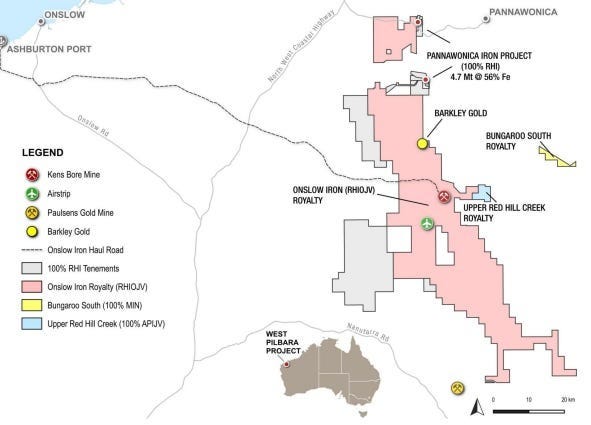
It’s logical for MinRes to pull both into the mine plan over time. Same haul road, same port, same blending operation. These stranded deposits become economic once the infrastructure is sunk.
Sandstone Gold Royalty - the next leg
In June last year, the RHI team completed the purchase of a 2% Gross Revenue Royalty (GRR) over a significant portion of the Sandstone Gold Project, being advanced by Brightstar Resources (BTR: ASX). The deal structure was unusually favourable for RHI: $4M cash up front to the pre existing royalty holders (Bruce Legendre and Stephen Stone), plus deferred contingent payments equal to 50% of royalty receipts from the first eight quarters of future production. A seemingly clean royalty, with no buydown clause I could find.
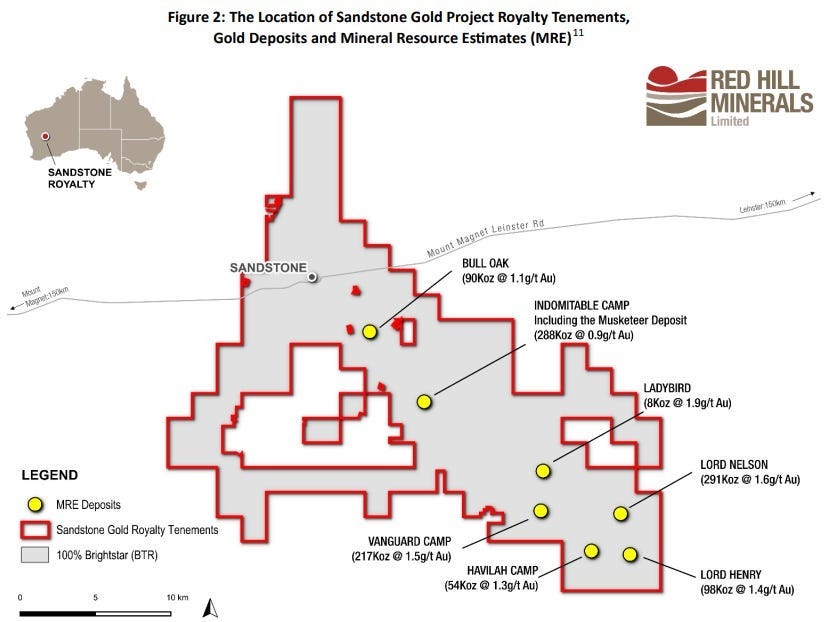
The royalty tenements cover approximately 443 km² and contain an unconstrained Mineral Resource of 23.5 Mt at 1.4 g/t Au for 1.05 Moz (or 17.7 Mt at 1.4 g/t for 0.83 Moz constrained within optimised pit shells at a $2,500/oz gold price), predominantly on granted mining leases. The deposits read as a cluster of previously mined supergene systems, in which the cut off grade has been lowered to optimise pit shells with minimal value created by the drill bit (Figures sourced from RHI announcement dated 18/09/2025).
Depending on your view of the future gold price, using a more favourable price in the shells would mean the optimisation would now capture far more material than the constrained 0.83 Moz. However, the project’s success is highly leveraged to the gold price, which is why this tenement has been dormant since Troy Resources last mined it in late 2010.
BTR is currently completing an ~9,100 m RC and DD program, designed to infill areas of the Mineral Resource at depth for inclusion in the PFS targeted for delivery in 2H’CY26. With four rigs turning and more than 70,000 m of drilling completed towards a material mineral resource upgrade, this is the aspect I am most excited about because it is a genuine test of the system at depth.
A caveat that’s easy to miss. The RHI royalty covers the tenements that Brightstar acquired from Alto Metals, including Lord Nelson, Lord Henry, Vanguard, Indomitable, Musketeer, and Bull Oak. It does not cover the entire hub, which is now marketed as containing 2.4 Moz at 1.5 g/t.
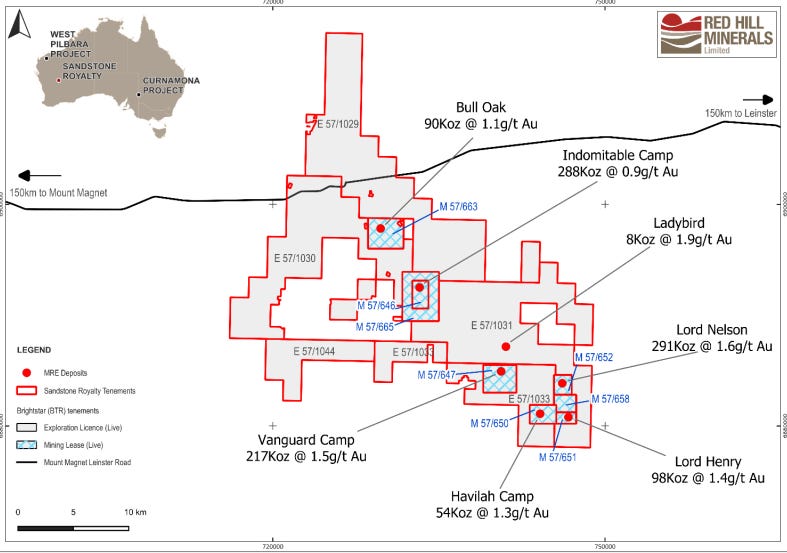
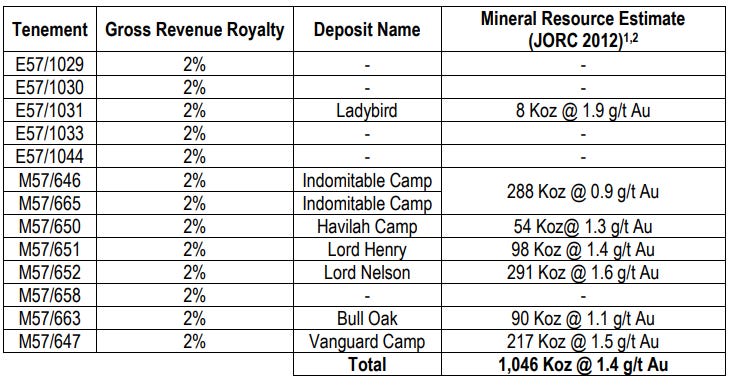
As stated earlier, the tenement holds large amounts of low grade ounces near the surface, mostly untested at depth, with assays rolling in and looking promising. If a low strip ratio can be achieved for near surface ounces, and grade firms up at depth, it seems very plausible that a hub and spoke approach can work as indicated by Brightstar.
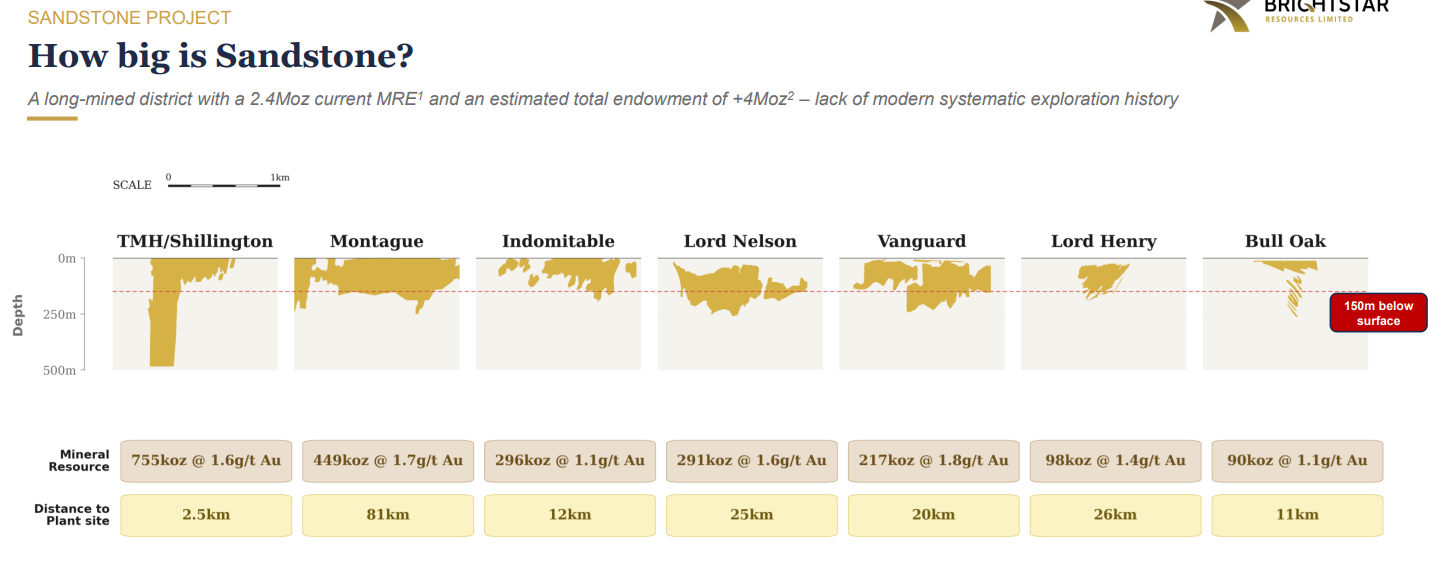
In my view, Sandstone is Brightstar’s company maker, the asset that enables district scale. The Goldfields hub looks like mediocre tier 3 ounces, in my opinion. It should be used to heavily cash flow the Sandstone drilling, and this will return the long term re rate they’ve struggled to claim from the market.
On the Geology side, RHI doesn’t hold a royalty interest in the Two Mile Hill; however, a recent announcement discussed findings at the Sandstone hub. A quick look at the cross section in this announcement suggests that the tonalite intrusion has some effect on gold precipitation, with mineralisation concentrating within the tonalite itself and along its boundaries.
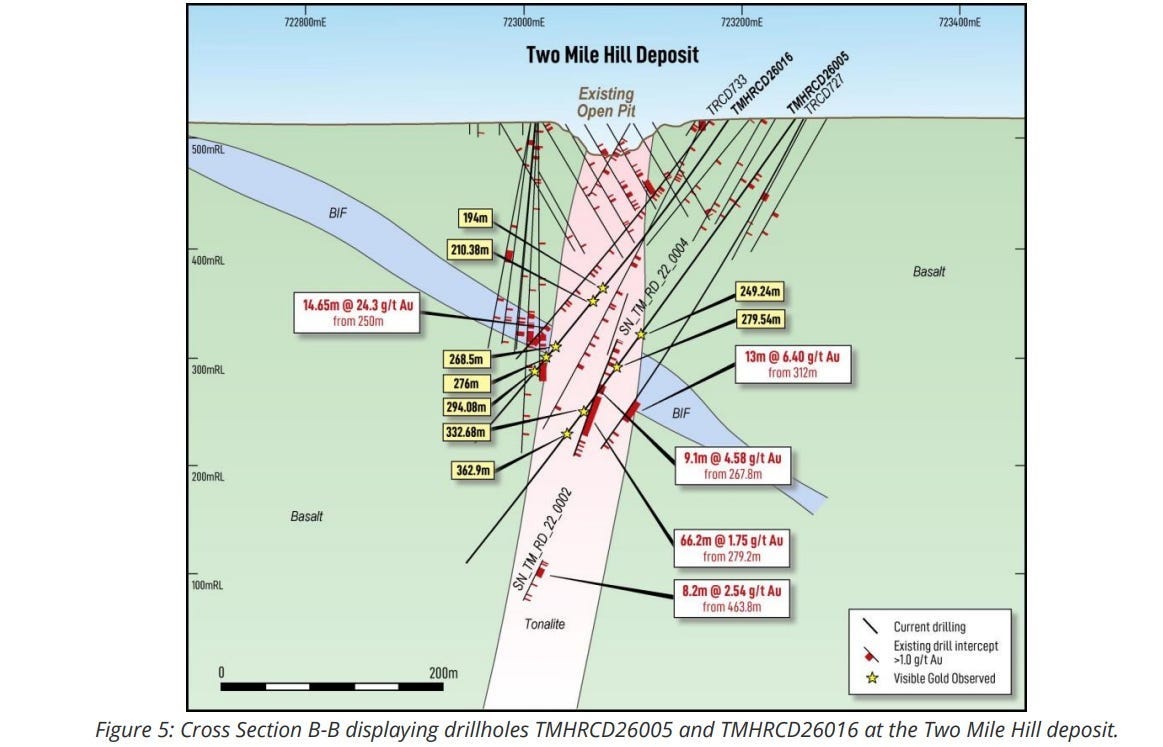
This is interesting, and here’s the part that reads through to the royalty ground, BTR describes Bull Oak with a similar geological setting to the Shillington-Two Mile Hill deposit: “Mineralisation is hosted by sheeted, shallowly east-dipping veins set within a granodiorite intrusion, with further mineralisation hosted by banded iron units (BIFs) truncated by the intrusion”. So the intrusion related, depth extensive style isn’t confined to the non royalty ground, it appears on the royalty deposits too, which supports the underground read.
Reported met results also don’t seem to be a problem, with recoveries up to 98%. I assume that these recoveries will decline once the MRE expands to include new drilling outside the oxide zone. The beauty of the GRR is that it pays on gross sales regardless of what the operator spends to extract, process and sell the metal. If processing costs blow out, that’s not RHI’s problem.
Thomson Intrusive Gold/Copper Royalty - Early Stage
In May 2025, RHI purchased the Thomson royalty, a 1.5% NSR overground held by Legacy Minerals (ASX: LGM) and Rio Tinto Exploration ground for $220,000 cash. LGM can buy back the royalty, one half of the royalty can be repurchased for $2M, with the remaining half for a further $4M ($6M for the full 1.5%).
Then, five months later, in October 2025, Rio Tinto Exploration took an option and staged farm in overground which includes the Thomson Project, with the ability to fund up to A$25m of staged exploration to earn up to 80%. As an RHI holder, you couldn’t ask for a better set up, one of the world’s largest miners paying to potentially unlock value across your ground.
This royalty is still in a very early stage and is worth little today. If it pays, it pays asymmetrically. Even if LGM exercises full buyback, that’s a 27x return on the $220k. If it doesn’t, the carrying cost is negligible.
Curnamona - Earn In JV
The Curnamona earn in JV gives Red Hill the right to earn 75% from Peel Mining (ASX: PEX) by spending $6.5M over five years across a 1,700 km² area in the Broken Hill province of New South Wales and South Australia.
The tenements for the Curnamona project sit northwest of Broken Hill, within the Curnamona Province neighbouring Gawler Craton, and are considered among the best terrain for a tier 1 copper discovery such as Olympic Dam, Oak Dam, and Carapateena. Lithospheric architecture of the Curnamona Province, Australia - ScienceDirect - reference on the province and the Gawler, further reading for readers
The main difficulties with IOCG discovery around the Curnamona Province and Gawler Craton is the amount of cover. These IOCG monsters are often hidden under 500m-1000m, which means exploration holes have to go deep. PEX seems to have some sniffs of mineralisation within historic drillholes, so that will at least give them a starting point.
My concern is whether the $6.5M expenditure commitment will be sufficient to make a genuine discovery across the project. With RHI writing the cheques and Peel carried down to 25%, the question is Red Hill’s appetite to spend. Gravity and magnetic surveys should help to pinpoint key prospects and anomalism, however, they would most likely require, a larger expenditure commitment to the tune of 15-20 M if serious drilling were to get underway.
Exploration - 100% Owned
Outside the royalties and Curnamona, RHI sits on a stack of 100% owned ground the market is ascribing minimal value to:
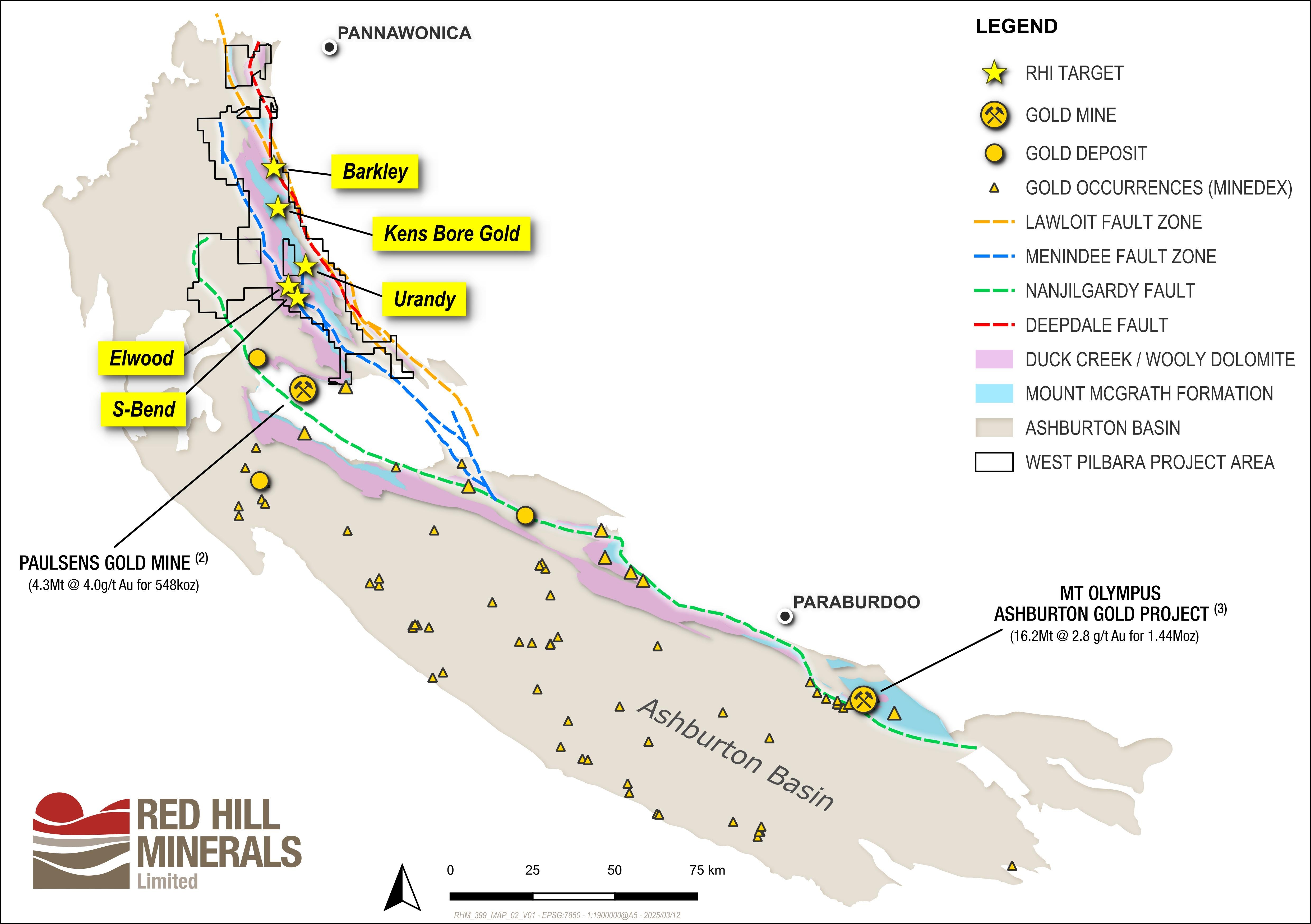
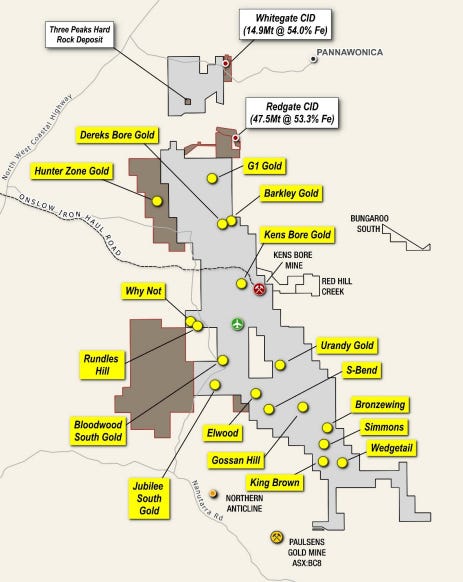
West Pilbara Gold & Base Metals (1,600 km2): Greenfields search with scattered hits. The south west boundary of the project is approximately 8km from the Paulsens gold mine, acquired by Black Cat Syndicate (ASX: BC8) from Northern Star (ASX: NST) in 2022.
Pannawonica: Stranded deposit with an Ore Reserve of 4.68Mt at 56% Fe (54.5% cut off grade), within a total Mineral Resource of 62.5Mt at 53.4% Fe (52% cut off grade) across Redgate and Whitegate, with a completed PFS on three granted mining leases.
Three Peaks: a porphyry rock quarrying/aggregate concept near Pannawonica. Insignificant, but cheap to carry.
Why this matters - the asymmetry
The company is run well. Exploration cash burn was $4.6M in H1 FY26, call it $9M annualised. This is comfortably covered, more than three times over, by $28.7M of expected FY26 royalty income, even if Onslow never runs above nameplate. The proof is in the balance sheet: after funding the drilling, the purchase of the Sandstone royalty and a fully franked dividend, cash and receivables still sat at ~$59M at the end of Q3 FY26.
How you read RHI depends on which lens you bring. A junior explorer and a royalty investor want different things, and that tension shapes how each sees the company.
As an explorer, you’re chasing discovery and you will wear risk to get it. On that view, RHI looks extremely rare, it doesn’t need an equity raise, doesn’t dilute, and isn’t eating into capital to keep the drill turning. Onslow pays for all of it, and that’s before the upside if Onslow exceeds nameplate capacity. Strip the royalty income out completely and the company still has the better part of seven years of runway at the current spend. Fully funded.
As a royalty investor, you want stable cash flow, minimal operating risk and predictable returns. On this view, the exploration spend, including the Curnamona earn in, is the sticking point. The royalty receipts are being redirected into the drill bit rather than returned, which is exactly what a pure royalty holder doesn’t want.
So it comes down to capital allocation. On the numbers, RHI’s expected ~$28.7M of royalty income against a ~$235M EV puts it at ~8x. RHI trades marginally below Deterra, the pure play royalty company that owns BHP’s Mining Area C (MAC) iron ore royalty. So you’re not overpaying, you’re buying RHI at a very reasonable royalty price for Onslow at 35Mtpa, while getting the gold and base metals options on top for nothing.
The catch isn’t the multiple, it’s what management does with the cash. A pure royalty company hands its receipts straight back, and the market pays up for that predictability. RHI instead recycles part of that royalty cash into the drill bit, which only makes sense if those dollars earn more than the cost of capital. Spend them well, and you don’t just collect the royalty but compound it into something far larger, with a real shot at creating a behemoth of a company. Given management’s alignment and track record, I think that’s a bet worth backing, but make no mistake, it is still a bet.
Disclaimer & Disclosure: This is not financial advice. I’m just a guy with a spreadsheet and an opinion, not a licensed advisor. Everything here reflects my personal view based on publicly available information at the time of writing - numbers, dates, and assumptions may be wrong, out of date, or just plain misread. I do not hold a position in ASX:RHI at the time of writing. This is disclosed for transparency, it does not change the analysis, but you should weigh my view accordingly.